
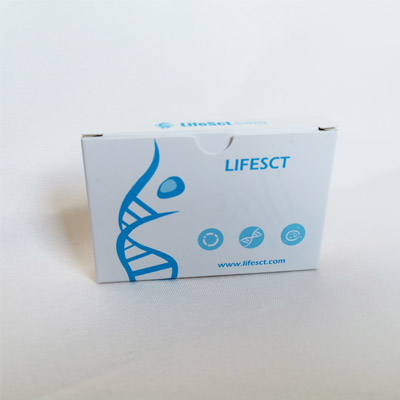

By utilizing our innovative and proprietary lipid conjugation technology, LiFect2K™ Transfection Reagent is formulated by addition of a booster peptide, giving rise to up to 20 times higher efficiency on variety of mammalian cells. LiFect2K™ was shown to efficiently deliver genes to various established cell lines as well as primary cells including HEK293, 293T, 293E, CHO, COS1, HeLa, NIH 3T3, insect cell lines (Sf9 and Sf21) and a variety of other eucaryotic cell lines with less toxicity. The reagent, 1.0 ml, is sufficient for 667 transfections in 24 well plates or 333 transfections in 6 well plates.
Key Features
• Superior transfection efficiency for a broad range of cell lines.
• Does not require removal of serum or culture medium.
• Does not require washing or changing of medium after transfection.
• Low cytotoxicity.
Component
1. LiFect2K™ Transfection Reagent: 3×1 ml
Storage
Store at 4°C.
Other Size
| Product Name | Cat. # | Price | View |
| LiFect2K™ Transfection Reagent (1 ml) | M0003-01 | $229 |  |
Case Study
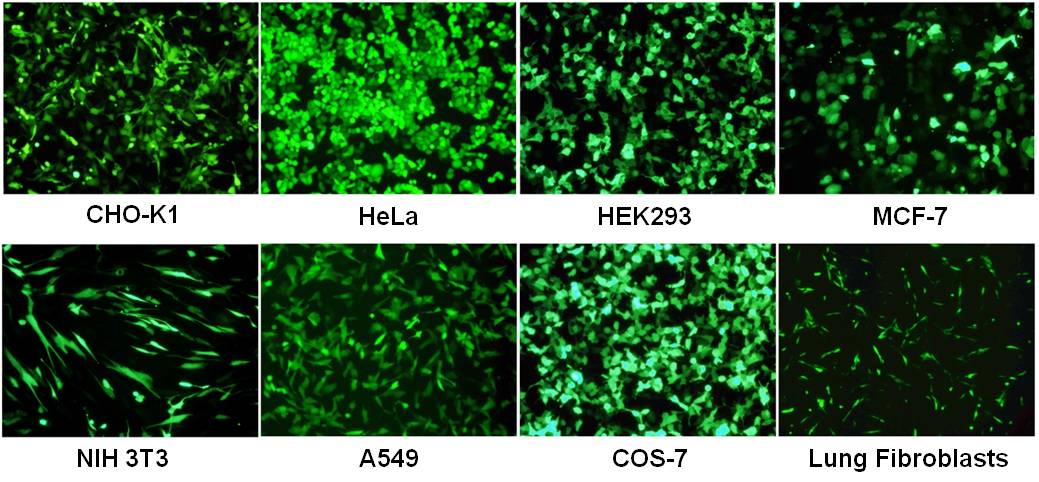
Assessment of LiFect2K™ transfection efficiencies using GFP visualization. 8 commonly-used cell lines were transfected with a GFP-expressing plasmid using LiFect2K™ transfection reagent. Cells were visualized 48 hours post-transfection under fluorescence microscopy (GFP filter).
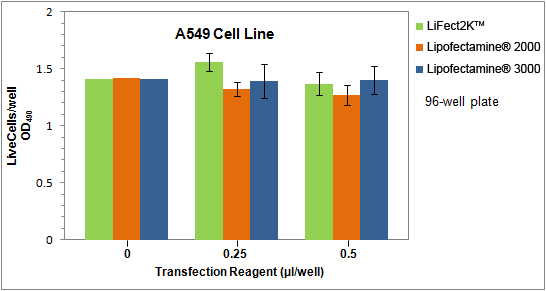
Comparison of cytotoxicity between LiFect2K™, Lipofectamine 2000 and Lipofectamine 3000.
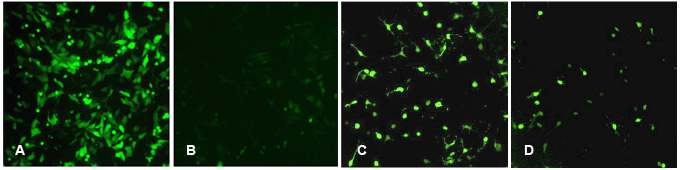
Figure A & B. Assessment of LiFect2K™ transfection efficiencies for siRNA. Hela cell line was transfected with either a GFP cDNA (A), or co-tranfected with GFP cDNA and an anti-GFP siRNA (B). siRNA transfection efficiencies were assessed by GFP signal.
Figure C & D. Comparison of LiFect2K™ and Lipofectamine 2000 in plasmid transfection on mouse neuronal cells. Mouse neuronal cells were transfected with a GFP-expressing plasmid using either LiFect2K™ transfection reagent (C), or Lipofectamine 2000 (D). Cells were visualized 48 hours post-transfection under fluorescence microscopy (GFP filter).